
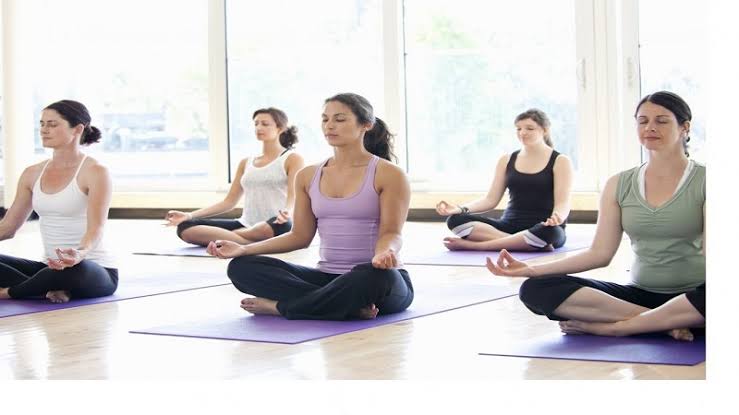
Dahn Yoga is an integrated mind-body training method that combines deep stretching exercises, meditative breathing techniques, and energy awareness training. Its objective is to help practitioners achieve their highest level of personal potential. The traditional name for Dahn Yoga is “Dahnhak,” which literally means “the study of energy.” In Korean, “Dahn” refers to the primal, vital energy which is essential to all life forms, and “Hak” refers to the study of a particular theory or philosophy.
Thus, a Dahnhak practitioner is one who studies the system of energy for the purpose of personal self-development. During Dahn Yoga training, practitioners learn to communicate with their bodies through energy. As the body’s energy circulation is stimulated, its innate natural healing power is activated. Through consistent practice, practitioners can lead themselves back to optimum health. Essentially, they regain true mastership over their bodies through the medium of energy (Ki).
The benefits of Dahn Yoga, however, extends well beyond physical health. For one thing, the concept of “health” is all-encompassing in Dahn Yoga. A truly healthy person not only has a fit and functioning body but also seeks balance and harmony in all areas of life. Practitioners of Dahn Yoga often report that through their practice, their family life improves, they gain confidence in their career, and many old and burdensome emotions are finally released.
When practitioners arrive at their goal of a healthy life, they often extend their intentions by creating harmonious relationships with their family, friends, communities, and nature. This helps them to become better human beings and creates a healthier, a happier, and more peaceful world.
What Are the Benefits?
Dahn Yoga was created for people who want to live better lives and gain flexibility and balance of body and mind, even while living their busy, hectic lives. One of the advantages of Dahn Yoga is that it is easy and simple enough for anyone to learn, yet challenging for even the most advanced practitioner. Anyone – male or female, young or old – can enjoy the various programs and benefits of Dahn Yoga. Regular practice can offer you the following benefits:
For your body
The combination of breathing techniques and deep stretching movements evenly work every muscle and joint in your body to:
- Increase flexibility and balance.
- Improve respiration, energy, and vitality.
- Improve bone density and muscle tone.
- Help maintain a balanced metabolism.
- Promote cardio and circulatory health.
- Help manage pain in the body.
- Increase circulation to all organs of the body.
For your mind
All postures in Dahn Yoga are designed to unify movement, breathing, and awareness. This is what makes Dahn Yoga different from ordinary stretching. Paying careful attention to proper posture while controlling your breathing and concentrating completely on the here and now can:
- Help you relax and handle stressful situations more easily.
- Teach you how to quiet the mind and concentrate well.
- Encourage positive thoughts and self-acceptance.
- Create centeredness and balance.
For your spirit
Dahn Yoga can be used purely to promote physical and mental well-being. However, this system is comprehensive, integrating not only the physical and mental but also the spiritual aspect of human existence. Dahn Yoga practice helps you develop a peaceful mind and stimulates your spirit to:
- Become aware of your body, your feelings, and the world around you.
- Help you feel whole and connected with humanity and nature.
- Help you find your life purpose and rekindle your passion for life.
How Is Dahn Yoga Different?
Dahn Yoga is similar to other forms of mind-body training, but it can be distinguished by three unique characteristics:
The mastery and use of energy
Energy is a defining element in Dahn Yoga because it is considered to be the medium that unites body and mind. Practitioners develop a deeper understanding of their bodies through energy while experiencing directly the connection between mind and body and strengthening communication between the two. From the perspective of energy, Dahn Yoga is made up of five stages: initiating, accumulating, controlling, commanding, and completing.
Practitioners first learn how to feel and accumulate energy in the major energy centers of the body. As the sense of energy gradually develops, formerly blocked energy channels open up, promoting circulation of energy throughout the body. Once able to control and command energy, practitioners experience natural healing in their bodies while gaining control of emotions and habits.
It is possible to follow Dahn Yoga training without feeling energy. However, when practitioners feel the energy, they experience the true character of Dahn Yoga and, more than anything else, the training itself becomes more joyful and grows into a multidimensional experience.
Enhancing the body-brain connection
Dahn Yoga contends that the brain is not simply an organ, but is, in fact, the center of the whole human body and its energy system. Through the various Dahn Yoga programs, practitioners can learn to utilize their brain fully toward the creation of
a better life for themselves and those around them. However, the power of the brain is not limited to individual and personal development. Just as the human brain can create strife and intolerance in the world, so too can it create a peaceful, healthy society.
Self-managed, holistic health care
The Dahn Yoga program includes principles and techniques for improving emotional patterns, as well as physical condition. In particular, it has many elements that improve the quality of social interaction and communication skills.
It is also helpful for correcting unhealthy habits, such as smoking, overeating, and the like. As will be explained in greater detail later, the key principles of Dahn Yoga and its systematic methods of training make this possible.
Where Did It All Begin?
The roots of the Dahn Yoga extend several thousand years back into Korean history. It began as a training program designed to educate the Korean population for the development of both mind and body. It was practiced on a daily basis with the intention of maintaining people’s health and developing their potential to become ideal humans.
Up until 2,000 years ago, this educational method was practiced and transmitted by wise men to each generation. Dahnhak contributed to the health and political unity of the Korean people for many hundreds of years. However, the Korean people failed to keep the Dahnhak tradition alive. During his personal journey toward self-realization and self-discipline, Ilchi Lee rediscovered the tradition and modernized it.
He first started teaching Dahnhak to a stroke patient he met in a small park in Anyang, Korea. In 1985, the first Dahn center opened in Seoul, Korea. Since that time, the program has expanded throughout the world with more than 600 centers offering Dahn Yoga to more than 200,000 active practitioners. The tradition of offering the exercises continues in thousands of public parks, schools, assisted living centers, and college campuses in Korea, the United States, Canada, Japan, and other countries.
Getting Started
Location
No, the specific location is necessary for Dahn Yoga training. It can be practiced indoors or outdoors. The training methods introduced here can be used in your office or at a rest stop when you need a break during a long road trip.
To enjoy the maximum benefits of Dahn Yoga, however, it’s good to have a set place for your practice. Choose a quiet location with little noise and enough space for stretching. Also, make sure that the temperature is neither too hot, nor too cold.
Clothing
Wear comfortable attire that does not inhibit movement. We recommend clothes made of a natural fiber that is absorbent, lightweight, and breathable. It’s a good idea to train without shoes, if possible.
Training time
It is best to train two to three hours after eating. Dahn training includes movements that bend the body forward or backward and twist it from side to side, so you might feel
discomfort if you train on a full stomach. Training in the morning is a great way to kick off an energy-filled day, but you should choose whatever time works best for you. Try to set a fixed time for training, if possible—ideally, one to one-and-a-half hours. However, if this is not practical, you should train for at least 20 minutes.
It is best to train every day, but if this is not possible, then two to three times a week is sufficient. Although this book will serve as a basic guide, the best way to learn Dahn Yoga is to get the instruction and guidance of a professional instructor at a Dahn center.
 Healthy Lifeline